
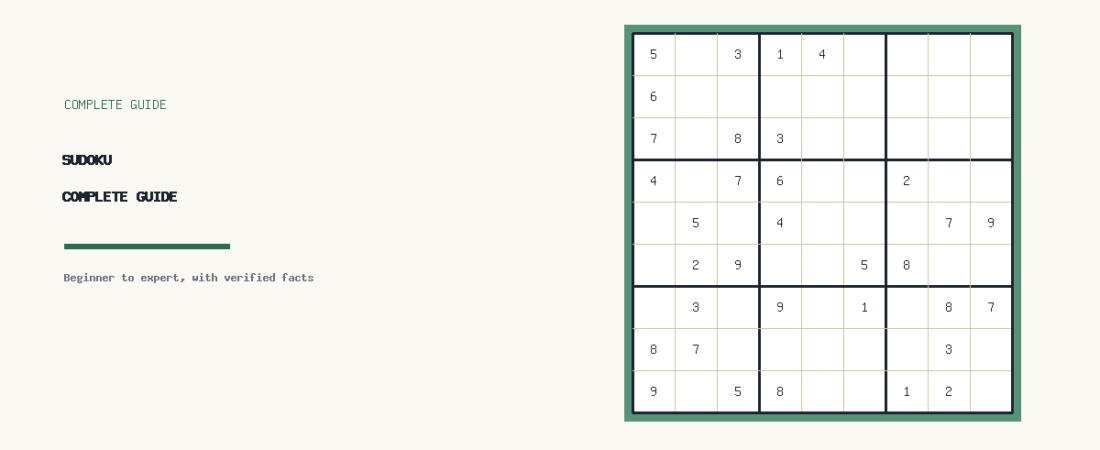
Sudoku looks like a maths puzzle and is not one. It uses the digits 1 to 9, but you never add, subtract or multiply anything. Replace the digits with nine letters, nine colours or nine shapes and the puzzle behaves identically. What Sudoku actually tests is your ability to eliminate possibilities in a structured way.
This guide covers the rules, the solving techniques that matter (in the order you should learn them), what difficulty labels really mean, the main variants, and a set of verified facts about the puzzle. Where popular sources get details wrong, this guide says so and explains what the primary research actually shows.
Quick Summary
- Fill a 9×9 grid so every row, every column and every 3×3 box contains the digits 1 to 9 exactly once.
- No arithmetic is required. Sudoku is a constraint puzzle, not a number puzzle.
- A properly constructed puzzle has exactly one solution, reachable by logic alone.
- Learn techniques in this order: scanning, single candidates, pencil marks, naked and hidden pairs, pointing pairs and box/line reduction, then X-Wing and wings.
- Difficulty labels are not standardised between websites, so “hard” on one site can mean “medium” on another.
- The minimum number of clues for a unique solution is 17, proven in 2012.
The Rules of Sudoku
A standard Sudoku is a 9×9 grid of 81 cells, divided by heavier lines into nine 3×3 boxes (also called blocks or regions). Some cells are filled in at the start. These are the “givens” or “clues”.
To solve the puzzle, fill every empty cell so that:
- Each row of nine cells contains the digits 1 to 9, each exactly once.
- Each column of nine cells contains the digits 1 to 9, each exactly once.
- Each 3×3 box contains the digits 1 to 9, each exactly once.
That is the entire rule set. Two pieces of terminology are worth learning early, because most guides use them without explanation:
- A band is a horizontal strip of three boxes (three rows of the grid).
- A stack is a vertical strip of three boxes (three columns of the grid).
- A unit or house means any single row, column or box: the three structures that constrain a cell.
Every cell sits inside exactly three units at once: one row, one column and one box. That triple overlap is the engine behind every technique in this guide.
A note on spelling
Many people search for this puzzle as “sodoku” or “suduko”. The correct spelling is sudoku, from the Japanese phrase sūji wa dokushin ni kagiru, which means roughly “the digits must remain single”.
There is a genuine reason to be careful with the “sodoku” spelling in particular. Sodoku is also the name of a real bacterial illness: a form of rat-bite fever caused by Spirillum minus, named from the Japanese so (rat) and doku (poison). If you search that spelling, medical results from sources like Orphanet and rare-disease registries will appear alongside puzzle results. The two words are unrelated.
How to Solve Sudoku: Techniques in Learning Order
Techniques should be learned in a specific sequence, because each one only becomes necessary when the previous ones stop producing progress. Trying to learn X-Wing before you are comfortable with pencil marks is the most common way beginners get frustrated.
Level 1: Scanning (crosshatching)
This is the first technique and it will solve most of an easy puzzle on its own.
Pick a digit, say 7. Look at a box that does not yet contain a 7. Now check every row and every column that passes through that box. Wherever a 7 already exists in one of those rows or columns, that entire line is eliminated inside your box. If only one empty cell survives, the 7 belongs there.
Work digit by digit, box by box. It feels slow at first and becomes near automatic within a few puzzles.
Level 2: Single candidates
Two closely related patterns, often confused:
- A naked single is a cell where only one digit is still possible, because the other eight already appear in its row, column or box.
- A hidden single is a digit that can only go in one cell of a unit, even though that cell might still have several candidates of its own.
Hidden singles are easier to miss and are worth actively hunting for. Scan each unit and ask “where can the 4 go in this box?” rather than only asking “what can go in this cell?”.
Level 3: Pencil marks (candidates)
Once scanning stops yielding placements, start writing candidates: the small notes listing which digits remain possible in each empty cell.
Two standard notation styles exist:
- Corner notation, with candidates written small in the corner of the cell.
- Centre notation, with candidates written in the middle, useful when a cell has many possibilities.
Pencil marking is not a crutch. It is standard practice at every skill level, including competitive play. Skipping it is the main reason players stall on medium puzzles.
Level 4: Naked pairs, triples and quads
If two cells in the same unit contain exactly the same two candidates and nothing else, those two digits must occupy those two cells in some order. They can therefore be eliminated as candidates from every other cell in that shared unit.
The same logic extends to three cells sharing three candidates (naked triple) and four sharing four (naked quad). The cells do not each need every candidate; the set just has to be confined to those cells.
Level 5: Hidden pairs
The mirror image of a naked pair. If two digits can only appear in the same two cells within a unit, then those two cells must hold those two digits, and every other candidate in those two cells can be deleted.
Hidden pairs are visually harder to spot because the useful information is buried among other candidates. As a practical rule: naked pairs are more useful early in a solve, when cells have few candidates; hidden pairs earn their value later, in cluttered grids.
Level 6: Pointing pairs and box/line reduction
These two are formally called locked candidates, and they are frequently mixed up.
- Pointing pair (or pointing triple): inside one box, a candidate digit is restricted to two or three cells that all sit in the same row or column. That digit must go somewhere in the box, so it can be eliminated from the rest of that row or column outside the box.
- Box/line reduction: the reverse direction. Within one row or column, a candidate is restricted to cells that all fall inside a single box. That digit can then be eliminated from the rest of that box.
Learning to tell these apart is the practical dividing line between medium and hard puzzles.
Level 7: X-Wing and the wings
At this point you are working with patterns spread across the whole grid.
- X-Wing: a candidate appears in exactly two cells in each of two different rows, and those cells line up in the same two columns. The candidate can then be removed from the rest of both columns. The same works with rows and columns swapped.
- Swordfish: the same idea extended to three rows and three columns.
- XY-Wing: three cells each holding exactly two candidates, arranged so that one “pivot” cell shares a unit with each of the other two. Whichever value the pivot takes, one of the other two cells is forced to a shared digit, which can be eliminated from cells seeing both.
- XYZ-Wing: as XY-Wing, but the pivot carries all three candidates, which narrows which cells the elimination applies to.
A technique that relies on the puzzle itself
Unique rectangle deserves a separate mention because it works differently from everything above. It assumes the puzzle has exactly one solution, then uses that assumption to rule out a pattern that would create two.
If the same two candidates occupy four cells forming a rectangle across two rows, two columns and exactly two boxes, with no other candidates present, the puzzle would have two valid solutions (the two digits could swap). Since a proper puzzle cannot, any extra candidate sitting in one of those cells must be the answer there.
This is logically sound only for properly constructed puzzles. It will mislead you on a badly generated one.
Is guessing allowed?
A properly built Sudoku never requires guessing. Every placement is deducible.
That said, experienced solvers do sometimes use bifurcation: picking one of two candidates, following the consequences, and backtracking if a contradiction appears. It is logically valid (it is proof by contradiction), and some competitive solvers use it when it is faster than hunting for an elegant pattern. Whether it counts as “real” solving is a matter of taste rather than logic. For learning purposes, avoid it: every time you guess, you skip the pattern you were about to learn.
What Difficulty Levels Actually Mean
Sudoku difficulty is defined by which techniques a puzzle requires, not by how many clues it shows. This is the single most misunderstood part of the puzzle.
| Level | Typical clues | Techniques usually required |
|---|---|---|
| Easy | 36 to 45 | Scanning, naked and hidden singles |
| Medium | 30 to 36 | Pencil marks, naked and hidden pairs |
| Hard | 26 to 32 | Pointing pairs, box/line reduction, triples |
| Expert | 22 to 28 | X-Wing, wings, unique rectangle, chains |
Treat these ranges as indicative rather than fixed. Two important caveats:
Clue count is a weak predictor of difficulty. A 30-clue puzzle can be easier than a 34-clue one if the clues are positioned to make hidden singles obvious. Some 17-clue puzzles solve with modest techniques, while some puzzles with far more clues need advanced patterns.
Labels are not standardised across sites. There is no governing body defining “hard”. Each site’s generator rates puzzles by its own solver, so an “expert” puzzle on one site can be equivalent to a “medium” elsewhere. If a difficulty level feels wrong, the label is often the problem rather than your ability.
Sudoku Variants Worth Knowing
Once classic 9×9 becomes routine, the variants offer genuinely different logic rather than just harder versions of the same thing.
- Killer Sudoku: cells are grouped into dashed “cages” with a target sum. Standard rules apply, plus each cage must total its given number with no repeats inside the cage. This one does involve arithmetic.
- Diagonal (Sudoku X): both main diagonals must also contain 1 to 9 exactly once, adding two more units.
- Jigsaw (Irregular): the nine regions are irregular shapes instead of 3×3 boxes.
- Mini Sudoku (4×4 and 6×6): smaller grids using 1 to 4 or 1 to 6. Genuinely useful for children and for learning the logic quickly, and increasingly common as a short daily puzzle format.
- Samurai Sudoku: five overlapping 9×9 grids sharing corner boxes.
- 16×16 (Hexadoku): uses digits and letters, with 4×4 boxes.
Mini Sudoku deserves particular attention if you are teaching someone. A 6×6 grid takes five to ten minutes and demonstrates every core concept without the intimidation of 81 cells.
Verified Facts About Sudoku
This section is worth reading carefully, because several widely repeated “facts” about Sudoku are wrong or garbled, including on otherwise reputable puzzle sites.
How many Sudoku grids exist
The number of valid completed 9×9 grids is exactly 6,670,903,752,021,072,936,960, roughly 6.67 sextillion. This was computed by Bertram Felgenhauer and Frazer Jarvis in 2005 and has been independently verified many times since.
The number of essentially different grids, meaning grids that cannot be turned into one another by relabelling digits, permuting rows and columns within bands and stacks, permuting the bands and stacks themselves, or transposing the grid, is 5,472,730,538. This result is due to Ed Russell and Frazer Jarvis.
A correction worth noting. Several sites present the second number as the first number divided by the size of the symmetry group (1,218,998,108,160), and describe the match as a consistency check. It is not a match. That division gives 5,472,447,994, which differs from the correct answer by about 282,544. The true count requires Burnside’s lemma, because a small fraction of grids map to themselves under some symmetry operation and therefore produce smaller orbits. Those self-symmetric grids are rare (roughly 0.005% of all grids), which is exactly why the division looks almost right.
The symmetry group itself is worth stating precisely: excluding relabelling it has order 3!^8 x 2 = 3,359,232, and including the 9! relabellings the full validity-preserving group has order 1,218,998,108,160.
The minimum number of clues
17. In 2012, Gary McGuire, Bastian Tugemann and Gilles Civario at University College Dublin proved that no 16-clue Sudoku has a unique solution, settling a question that had been open for years. Their method reformulated the problem as hitting set enumeration and required roughly 7 million CPU-hours.
A second correction. At least one popular article states that the team “checked all 49,158 equivalence classes of 16-clue puzzles”. This conflates two separate numbers. The figure 49,158 is the count of known essentially different 17-clue puzzles, a catalogue initiated and long maintained by Gordon Royle. It has nothing to do with 16-clue configurations, and the completeness of that 17-clue list has never been proven.
Other verified points
- Sudoku is a constrained form of a Latin square, with the 3×3 box rule added on top.
- The generalised n²xn² Sudoku problem is NP-complete, shown by Takayuki Yato and Takahiro Seta in 2003. Standard 9×9 puzzles are trivial for computers because the size is fixed.
- The largest known minimal puzzle (one where no clue can be removed without creating extra solutions) has 40 clues.
The history, accurately
- 1783: Leonhard Euler formalises Latin squares. These are an ancestor of Sudoku, not Sudoku itself, since they lack the box constraint.
- 1890s: French newspapers publish number-grid puzzles with some similar features.
- 1979: The modern puzzle appears in Dell Pencil Puzzles and Word Games as Number Place. It is attributed to Howard Garns, a retired architect and freelance puzzle constructor from Indiana. Worth knowing: Garns was never credited in print during his lifetime. The attribution was reconstructed later by puzzle historians, notably Will Shortz and Ed Pegg Jr. He died in 1989, before the puzzle became famous.
- 1984: Japanese publisher Nikoli reprints it. Maki Kaji gives it the name that is shortened to Sudoku. Nikoli also standardised conventions such as symmetric clue placement.
- 2004: Wayne Gould, a retired judge from New Zealand, persuades The Times of London to run his computer-generated puzzles. The first appeared on 12 November 2004, and global newspaper adoption followed within months.
One consequence of the Nikoli connection: “Sudoku” is a trademark in Japan, which is why Japanese publications often still call the puzzle Number Place or nanpure.
Does Sudoku Actually Improve Your Brain?
This deserves an honest answer, because the claims made online are usually stronger than the evidence.
What the research shows. The most cited work is from the UK PROTECT study. Brooker and colleagues (2019, International Journal of Geriatric Psychiatry) analysed roughly 19,000 adults aged 50 and over and found that the more frequently people used number puzzles, the better they scored on tests of attention, reasoning and memory. A companion 2018 paper found the same pattern for word puzzles.
What it does not show. Three important limits:
- The study is cross-sectional and correlational. It compares people at one point in time. It cannot establish that puzzles cause better cognition. As one independent researcher commented at the time, it is entirely plausible that people with sharper cognition simply enjoy these activities more and do them more often.
- Lead author Anne Corbett stated directly that the results do not show that puzzles reduce dementia risk.
- The frequently quoted figures of “ten years younger” for reasoning and “eight years younger” for short-term memory come from the word puzzle paper. Several Sudoku sites reattribute the ten-year figure to daily number-puzzle players. That is a misreading.
A fair conclusion. Sudoku is a genuinely engaging cognitive activity, it is associated with better cognitive scores in large samples, and it is a reasonable component of an active mental life alongside sleep, exercise and social contact. Claims that it prevents dementia or raises IQ are not supported.
Sudoku in India, the US and the UK
The puzzle is the same everywhere, but the surrounding ecosystem differs in ways worth knowing.
India
India has the most active competitive Sudoku structure of the three, organised by Logic Masters India (LMI), the Indian affiliate of the World Puzzle Federation. LMI has run national championships since 2008 to select the Indian team for the world championships, and runs two well-known annual online series: Sudoku Mahabharat and Puzzle Ramayan, both open to international solvers.
Most significantly for 2026: India is hosting the 19th World Sudoku Championship and the 33rd World Puzzle Championship in Kolkata from 11 to 18 October 2026, at The Westin Kolkata Rajarhat, organised by LMI. For Indian players, that makes this an unusually good year to move from casual solving into the competitive scene, since qualification routes run through LMI’s online rounds.
United States
The puzzle originated in the US as Number Place but arrived at mass popularity only after the UK newspaper boom. American engagement today is largely app-driven and newspaper-syndicated, with a strong culture around daily puzzles and streaks.
United Kingdom
The UK is where Sudoku became a global phenomenon, through The Times in late 2004. Newspaper puzzle sections remain a meaningful part of UK solving habits, alongside apps, and British papers still publish daily graded puzzles.
Common Mistakes That Keep Players Stuck
- Guessing early. If you cannot justify a placement, leave the cell empty. A wrong entry propagates quietly and surfaces twenty moves later.
- Ignoring boxes. Rows and columns are easier to scan visually, so beginners underuse the box constraint, which is often exactly where the puzzle wants you to look.
- Refusing pencil marks. Trying to hold candidates in memory works on easy puzzles and fails on medium ones.
- Not re-scanning after a placement. Every digit you place changes three units. Check them immediately, because placements tend to cascade.
- Only looking for naked singles. Asking “where can this digit go in this unit?” (hidden singles) finds placements that cell-by-cell scanning misses.
- Blaming yourself for the difficulty label. Since labels are not standardised, a puzzle marked “medium” may genuinely require hard-level techniques.
Frequently Asked Questions
Is it spelled sodoku or sudoku? Sudoku is correct. “Sodoku” and “suduko” are common misspellings. Separately, sodoku is also the name of a rat-bite fever caused by Spirillum minus, so that spelling returns medical results as well as puzzle results.
Do I need to be good at maths? No. The digits are labels, not quantities. Nothing is calculated. The one exception is Killer Sudoku, where cage sums do require simple addition.
How long should a puzzle take? Beginners typically take 15 to 30 minutes on an easy puzzle, dropping under 10 minutes with practice. Expert puzzles can take experienced solvers 20 to 45 minutes or more.
Can every Sudoku be solved without guessing? Yes, if it is properly constructed with a unique solution. If you feel forced to guess, there is almost always a technique you have not applied yet.
What is the fewest clues a Sudoku can have? 17, proven in 2012. Fewer than 17 clues always produces either no solution or multiple solutions.
Which technique should I learn next? Whichever one your current puzzles are failing on. If you stall with a full grid of pencil marks, learn naked and hidden pairs. If pairs are not enough, learn pointing pairs and box/line reduction. Only then move to X-Wing.
Where to Go From Here
Pick a difficulty where you succeed roughly four times out of five, then move up. Solving puzzles far above your level teaches frustration rather than technique.
A practical progression:
- Solve easy puzzles until scanning and hidden singles are automatic.
- Move to medium and force yourself to use full pencil marks on every solve.
- Add naked and hidden pairs, then locked candidates.
- Move to hard, and learn X-Wing when locked candidates run out.
- Try a variant such as Killer or Jigsaw to keep the logic fresh.
Sudoku rewards patience far more than talent. The rules take two minutes to learn, and the ladder of techniques above will keep producing new things to notice for years.