
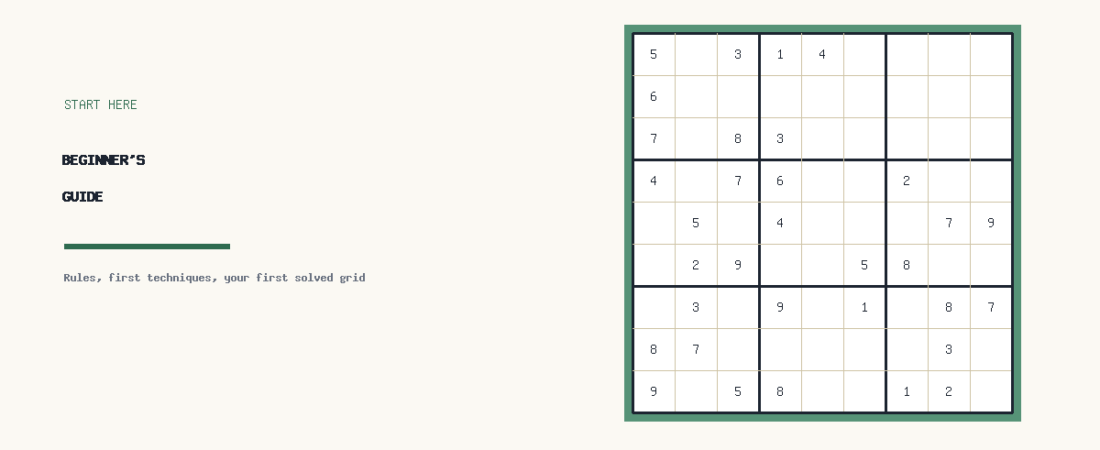
Sudoku looks intimidating the first time you see it — an 81-square grid dense with numbers and empty boxes. But the rules are genuinely simple, and almost anyone can solve their first puzzle within half an hour of picking it up. This guide breaks down exactly how the grid works, what the rules actually mean in practice, and three beginner-friendly techniques you can use immediately, whether you’re solving on paper or playing free online Sudoku.
By the end, you’ll understand why Sudoku never requires guessing, how to avoid the mistakes that trip up almost every new player, and where to go next once the basics feel comfortable.
- Sudoku is a logic puzzle played on a 9×9 grid divided into nine 3×3 boxes.
- Each row, column, and box must contain the digits 1–9 exactly once.
- No math is required — the numbers are just symbols.
- Every valid puzzle has exactly one solution, reachable through logic alone.
- Scanning, pencil marks, and elimination are the three techniques every beginner needs first.
What Is Sudoku, Exactly?
Sudoku is a number-placement puzzle built on a 9×9 grid, which is further divided into nine smaller 3×3 boxes. Some cells start with numbers already filled in — these are called “givens” or “clues.” Your job is to fill in the remaining empty cells so that three conditions are all true at once:
- Every row (left to right) contains the digits 1 through 9, with no repeats.
- Every column (top to bottom) contains the digits 1 through 9, with no repeats.
- Every 3×3 box contains the digits 1 through 9, with no repeats.
That’s the entire rule set. There’s no arithmetic involved — despite using numbers 1 through 9, Sudoku is a logic puzzle, not a math puzzle. You could just as easily play it with nine colors or nine letters and nothing about the difficulty would change.
Reading the Grid: Rows, Columns, and Boxes
Before solving anything, it helps to get comfortable identifying the three structures you’re working with:
Rows
A row is a horizontal line of 9 cells running across the grid. There are 9 rows total, and each one needs every digit from 1 to 9 exactly once.
Columns
A column is a vertical line of 9 cells running down the grid. Like rows, there are 9 columns, each needing all nine digits without repetition.
Boxes
A box (sometimes called a “region” or “block”) is one of the nine 3×3 clusters marked off by bold lines. Boxes are what make Sudoku different from a simple number-grid puzzle — they add a third overlapping constraint on top of rows and columns.
Here’s the key insight beginners often miss: every single cell belongs to all three structures at once. A cell in the top-left corner is part of the top row, the leftmost column, and the top-left box. That overlap is what makes elimination possible — and it’s the foundation of every Sudoku strategy that follows.
Your First Sudoku Strategy: Scanning
Scanning is the simplest and most important beginner technique. Here’s how it works:
- Pick a digit, say 7.
- Look at a box that doesn’t yet contain a 7.
- Check which rows and columns passing through that box already contain a 7 elsewhere on the grid.
- Cross those rows and columns off within the box — a 7 can’t go there.
- If only one empty cell in the box remains uncrossed, that’s where the 7 belongs.
Repeat this process for each digit, box by box, and you’ll fill in a surprising number of cells on an Easy puzzle before you need any other technique.
Your Second Strategy: Pencil Marks (Candidates)
Once scanning alone stops filling in new cells, it’s time to start tracking “candidates” — the small numbers Sudoku players jot into the corner of a cell to note which digits are still possible there. This is often called making pencil marks.
For any empty cell, list every digit 1–9 that isn’t already used in its row, column, or box. If you narrow a cell down to just one possible candidate, that’s your answer. If two cells in the same row, column, or box are both narrowed to the exact same pair of candidates, that’s a “naked pair” — a more advanced pattern covered in our Sudoku Tips & Strategies hub.
Your Third Strategy: Elimination by Row and Column
Elimination extends the same logic from boxes to entire rows and columns. If a row already contains eight of the nine digits, the ninth digit must go in the one remaining empty cell — no further checking required. This is often the fastest way to finish off the last stretch of an Easy or Medium puzzle.
Ready to put these techniques into practice?
Try them out on a real puzzle — no download, no sign-up.
Play Free Sudoku NowCommon Beginner Mistakes to Avoid
1. Guessing too early
New players often place a number because it “feels right” rather than because logic confirmed it. This almost always leads to a contradiction later in the puzzle. If you can’t justify a number using scanning, pencil marks, or elimination, leave the cell empty and move on.
2. Ignoring boxes in favor of rows and columns
It’s tempting to focus only on rows and columns since they’re easier to scan visually. But the box constraint is just as important, and many beginner puzzles are specifically designed to require box-based logic.
3. Not using pencil marks
Trying to solve everything in your head works for Easy puzzles but breaks down quickly on Medium and Hard grids. Writing candidates down (or using the built-in notes feature in a digital Sudoku app) is standard practice even for experienced solvers.
4. Losing track of which numbers are “given”
Confusing your own entries with the puzzle’s original clues makes it hard to backtrack if you spot a mistake. On paper, many solvers circle or underline the given numbers; digitally, most Sudoku apps — including PuzzleWorks’ online Sudoku game — shade given cells differently by default.
Sudoku Etiquette: Notation Systems Solvers Actually Use
As you move past your first few puzzles, you’ll notice experienced solvers all use a similar shorthand for pencil marks, whether on paper or in an app. Getting comfortable with this early saves you from relearning your note-taking habits later:
- Corner notation: small candidate digits written in the corner of a cell, usually in numerical order (1–9 reading left to right, top to bottom).
- Center notation: all candidates written small in the center of the cell, used when a cell has many possibilities and corner space runs out.
- Color coding: some solvers shade or color candidates that belong to a specific pattern (like a pair or a chain) to make advanced techniques easier to visualize.
Most digital Sudoku apps, including the PuzzleWorks online game, handle basic candidate tracking automatically once you toggle notes mode — but understanding the manual system helps when you eventually solve from a printable puzzle.
Easy vs. Medium vs. Hard: What Actually Changes
A common misconception is that harder Sudoku puzzles simply have fewer starting clues. Clue count matters less than most people assume — what really defines difficulty is which techniques are required to reach a solution.
| Level | Typical clues | Techniques usually required |
|---|---|---|
| Easy | 36–40 | Scanning, basic elimination |
| Medium | 30–35 | Pencil marks, naked/hidden pairs |
| Hard | 26–30 | Pointing pairs, box-line reduction |
| Expert | 22–26 | X-Wing, Swordfish, chains |
For a deeper breakdown of each tier, see our full guide to Easy, Medium, and Hard Sudoku. If you want to jump straight in, our online Sudoku game lets you pick a difficulty and see these differences firsthand.
Real-World Impact: Why Sudoku Has Stayed Popular
Sudoku’s appeal has held up for decades because the game asks nothing of language or vocabulary — it’s pure logic, which is part of why it spread globally as a newspaper puzzle long before smartphones existed. Cognitive research on puzzle-based games consistently points to short-term benefits for working memory and sustained attention, which helps explain why Sudoku remains a staple in both print puzzle sections and mobile app stores. It also scales cleanly: the same 9×9 grid works as a two-minute coffee-break puzzle or a slow, hour-long unwind, depending on the difficulty you choose.
A Worked Example: Solving Your First Few Cells
Let’s walk through a simplified example of scanning in action. Imagine the top-left box of a puzzle is missing a 4, and you can see a 4 already placed in the third row (outside that box) and another 4 placed in the second column (also outside that box). Within the top-left box, that eliminates every cell in the row and column those two 4s occupy. If only one empty cell in the box is left uncrossed, you’ve found your placement — no ambiguity, no guessing.
This is the exact process repeated, digit by digit and box by box, across the whole grid. It feels slow at first, but most solvers find it becomes close to automatic after a handful of puzzles. If you want to practice this specific pattern without committing to a full grid, our online Sudoku game lets you use the built-in hint feature to check your reasoning as you go, cell by cell.
One more habit worth building early: after placing a number, briefly re-scan the row, column, and box it belongs to. New placements often immediately reveal the next one, especially in the closing stages of a puzzle where only a few empty cells remain.
Where to Go From Here
Once you can consistently finish Easy puzzles using scanning, pencil marks, and elimination, you’re ready to progress. Here’s a suggested path:
- Read our breakdown of Easy, Medium, and Hard Sudoku to understand what changes at each level.
- Explore intermediate strategies like naked pairs and pointing pairs.
- When you’re ready for real challenge puzzles, our advanced solving guides cover techniques like X-Wing and Swordfish.
- Prefer pen and paper? Grab a free printable Sudoku pack.
Key Takeaways
- Sudoku’s rule set is simple: 1–9 once each in every row, column, and 3×3 box.
- No math skills are needed — only logic.
- Scanning, pencil marks, and elimination will solve nearly every Easy puzzle.
- Guessing isn’t necessary in a properly constructed puzzle — if you’re stuck, look for a pattern you haven’t tried yet.
- Difficulty increases as puzzles require more advanced techniques, not bigger grids.
Frequently Asked Questions
Is Sudoku hard to learn?
No. The rules take about two minutes to learn: fill the grid so each row, column, and 3×3 box contains 1 through 9 exactly once. Getting fast takes practice, but understanding the game is immediate.
Do I need math skills to play Sudoku?
No. Sudoku uses the digits 1–9 as symbols, not as numbers to calculate. You could replace them with letters or colors and the logic would be identical.
How long does it take to solve a beginner Sudoku puzzle?
Most beginners take 15 to 30 minutes on an Easy puzzle. With practice using scanning and pencil marks, that typically drops to under 10 minutes.
Is guessing ever necessary in Sudoku?
No. Every properly constructed Sudoku puzzle has exactly one solution reachable through logic alone. If you feel you have to guess, it usually means there’s a technique you haven’t spotted yet.
Conclusion
Sudoku rewards patience more than talent. The rules take minutes to learn, but the depth — from basic scanning to advanced elimination chains — is enough to keep players engaged for years. Start with an Easy puzzle, lean on scanning and pencil marks, and resist the urge to guess. The logic is always there if you look for it.
Ready to try it yourself? Play a free Sudoku puzzle now, or explore more guides in Beginner Sudoku. If this guide helped, share it with someone learning Sudoku for the first time.
Further reading: Sudoku on Wikipedia for the puzzle’s history and mathematical background.